
 REGISTER
 LOGIN


 Updated

Since the Trump administration announced reciprocal tariffs on virtually every other nation, financial markets have been experiencing heightened volatility driven by mixed reactions from investors.
In particular, the forex markets have been saddled with uncertainty. Countries heavily reliant on exports to the US are facing currency deprecation, while surprise gains are being seen in other currencies, even outside of the usual suspects.
And perhaps the biggest driver of uncertainty is how the US Dollar has steadily weakened – in seeming defiance of Trump’s original intent.
Contributing to the volatility are several other factors, including President Trump’s unpredictable style and sudden tariff escalations; retaliatory actions by China, the EU and Canada; growing concerns over global trade disruption; and disappointing US economic data leading to greater recession fears – to name but a few.
In response, forex traders are watching the markets closely for short-term opportunities, while increasingly hedging their positions. But while a degree of volatility is healthy for forex traders, too much volatility can muddy the waters and increase risk.
Amidst the uncertainty, forex affiliates can step up to support their audiences. Since there is a heightened need among traders for guidance on how to navigate current market conditions, forex affiliates acting as a reliable source of information can build trust, grow their following and even increase referrals.
This article explores actionable insights that may help affiliates better understand the current trading environment.
Understanding the market’s reaction to Trump’s tariffs
Let’s start by analysing the market’s reaction to Trump’s tariffs.
Although not explicitly stated as a goal, one expected outcome of Trump’s reciprocal tariffs was a strengthening of the US Dollar. The theory goes that by reducing trade surplus, demand for the Dollar would increase, helping to improve the American economy.
Many traders initially expected the USD to strengthen in response to tariffs, riding the inevitable uptrend all the way, right?
This did not happen; the opposite did. As shown by the US Dollar Index (USDX) – a measure of the strength of USD against a basket of six currencies belonging to America’s most significant trading partners–the Dollar has actually been on a decline in the past six months [1].

The USDX is considered a “generalised” view of things, an indication of the fair value of the Dollar in global markets. At the time of writing, it shows the Dollar is clearly under pressure, with an index reading of 98.8. When zoomed in to actual currency pairs, it stands to reason that volatility is much more pronounced.
Currency pair volatility
Here’s a look at how some currency pairs have been performing since the unleashing of Trump’s tariffs.
EUR/USD
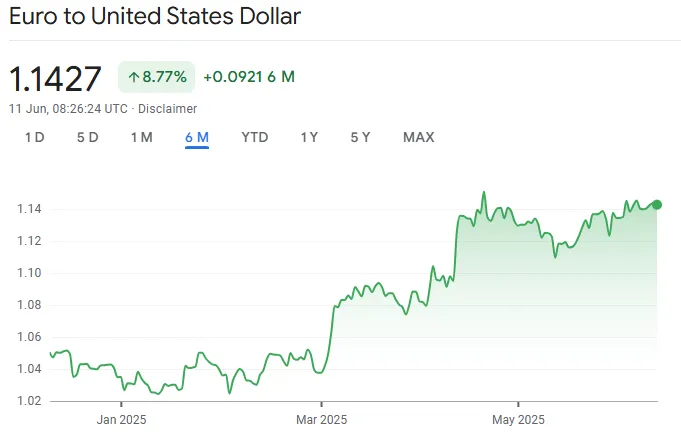
The EUR/USD is among the most popular forex pairs in the market, enjoying daily trading volume that regularly outstrips those of other major currency pairs.
The 6-month chart of EUR/USD, shown above, tells a clear story. Ever since the tariffs were launched, the euro has chartered a strong uptrend against the Dollar. Analysts attributed this rise in part to a perceived loss of confidence in the US economy on the back of worsening of labour data, as well as tariff-induced recession fears – sometimes referred to as the “sell America” trend.
EUR was buoyed by capital inflows from risk-averse investors, who flocked to the euro partly in the belief of more stable economic policies in the Eurozone and the UK. This shift in sentiment contributed to EUR/USD reaching a two-year high.
JPY/USD
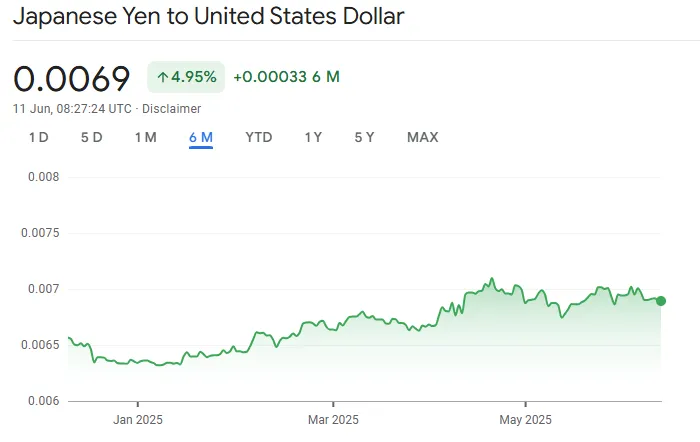
Another popular forex pair is JPY/USD. Given that Japan is the 3rd-largest economy in the world, and Tokyo’s status as a leading financial hub, the Yen stands among the most highly traded currencies in the world. It is especially popular as a funding source in carry trade strategies, given its historically near-zero interest rates.
Here, we can see that the Yen also benefited from Trump’s tariffs, experiencing a slight uplift against the Dollar. This is largely attributable to the Japanese currency’s status as a safe haven asset; as tariffs brought uncertainty to the markets, investors turned to the Yen to hedge against risk.
CNY/USD
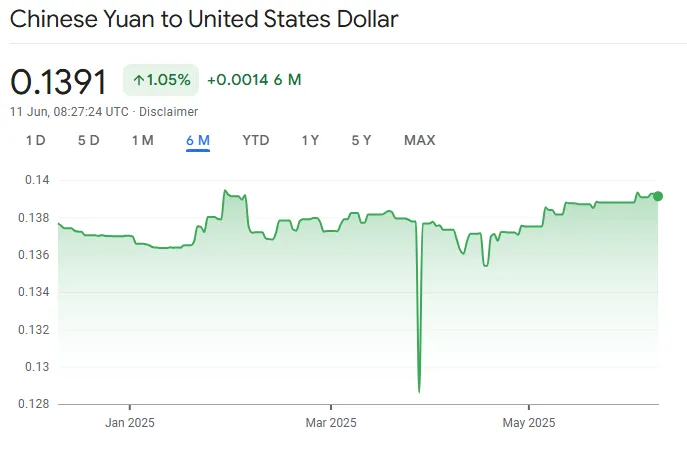
China is the largest target of the Trump administration’s global tariffs, being saddled with a mind-boggling 245% tariff rate at one point. This naturally brought up fears of the renminbi crashing against the Dollar.
Except for a transient plunge on 27 March 2025, this scenario did not come to pass. The Yuan was kept stable thanks to the Chinese government’s tight controls over monetary policies and capital outflow. Additionally, the large trade surplus enjoyed by China also helped maintain demand for CNY, further stabilising the currency against the Dollar.
To further absorb tariff impact, China’s central bank can also strategically depreciate the Yuan in a controlled manner, although according to various analysts in order to avoid triggering wider financial market instability.
Safe-haven currencies during tariff-related uncertainty
In forex trading, certain currencies are regarded as safe havens, increasing in demand during times of uncertainty. These currencies share common characteristics, such as being highly liquid, have relatively low inflation, and are issued by stable political systems in economically robust countries [2].
In general, the Japanese Yen (JPY), Swiss Franc (CHF) and United States Dollar (USD) are considered to be popular safe-haven currencies. Because forex traders trust their stability, demand for such currencies tends to go up during times of increased volatility. The increased demand helps these currencies maintain or appreciate in value against other currencies, creating a feedback loop that keeps demand going.
However, because the current forex volatility is caused by Trump’s tariffs (which could turn out to be more harmful than helpful to the American economy in the short run), USD has fallen out of favour as a safe-haven currency.
As we saw earlier, this role has (at least for now) been supplanted by EUR, as investors currently consider the Eurozone and UK to be more economically viable than the US, given the unpredictability of the tariff war. Meanwhile, JPY and CHF continue to be favoured by forex traders seeking safety.
Impact on trading sentiment
The pivot from USD to EUR as safe-haven serves to underscore just how much uncertainty and volatility Trump’s trade tariffs have brought to bear on the forex market. It follows that recent events have more than a passing impact on trading sentiment.
One particularly challenging aspect of the trade tariffs comes from Trump himself. The President is known for being unpredictable, arguing that this strengthens America’s foreign policy footing [3].
However, Trump’s unpredictable policy style has contributed to uncertainty in the global financial markets. In March, near-daily contradictions about trade tariffs caused a 10% plunge in the S&P 500; markets convulsed on the sudden announcement of a 90-day tariff pause; and more recently, a sudden doubling of tariffs on imported steel and aluminium to 50% caused the Dollar to fall by 0.8% against the euro and the Yen [4].
Some traders appear to be turning away from risk amid ongoing uncertainty, causing downward pressure on risk-sensitive currencies such as AUD, NZD and CAD. In particular, Canada is impacted by the snap tariff hike to 50% for steel imports, which is expected to further pressure the Canadian Dollar [5].
As forex traders retreat from risk-sensitive currencies, there is also a surge towards safe-haven currencies, for reasons already discussed above. Thus, another way that trading sentiment has been impacted is increased demand for currencies like CHF, JPY, and EUR.
Besides seeking safety and avoiding risk, forex traders may also adapt their behaviours in favour of clarity. They may refrain from trading, and instead wait things out until the outlook becomes clearer.
Key challenges and opportunities for forex affiliates
Given the current circumstances, what can forex affiliates do to better support their audiences? Let’s discuss some key challenges and opportunities for insights.
Challenges for forex affiliates
With the continued threat of surprise announcements, ongoing trade tension between two of the world’s largest economies, and lowering confidence in the global reserve currency, forex affiliates face increased market volatility. This is further exacerbated by the fact that no one knows when the impact of Trump’s trade tariffs will end, or how they will play out.
Adding another layer of uncertainty is the reaction of other countries. While some, like China, Canada and Mexico have chosen to retaliate with tariffs of their own, the vast majority of US trading partners are seeking to negotiate. Whether retaliation or talks, it’s hard to predict how these events will play out.
If there’s one thing we can count on is that uncertainty always translates to increased volatility on price charts. This can make it more for traders to interpret market movements using standard technical analysis methods. Traders would be well-served to expand their knowledge of technical indicators, learn how to choose the right indicators, and combine multiple indicators to more accurately confirm or deny trading signals.
Greater volatility also means that forex traders face greater risk, with higher potential for positions to move in unexpected ways. This increases the risk of margin calls due to price spikes that push positions out of place, putting increased stress on trader budgets. All these can heighten trader fear, making them hesitate to place trades.
As a forex affiliate, your income depends in part on the levels of trading activity carried out by your referrals. If your traders avoid trading because of uncertainty and fear, your earnings will take a hit. Thus, it is essential that you recognise these challenges faced by your audience, and do your best to help your referrals overcome them.
Opportunities for forex affiliates
Increased uncertainty may cause less experienced investors to refrain from trading, but more experienced traders will likely react differently. Some experienced traders may continue to trade actively during volatile periods, aiming to identify potential short-term opportunities. Additionally, staying in the market allows experienced traders to spot unexpected or rare trading opportunities that they might otherwise miss.
Investors will increasingly demand good quality educational resources on how to navigate tariff-driven forex markets. Forex affiliates who provide valuable educational content may strengthen their reputation and engagement, which can support their affiliate efforts.
In a similar vein, traders will pay more attention to effective risk management to limit losses and enhance profits. Focusing on teaching the proper use of risk management tools and techniques can also be a good tactic for forex affiliates to increase trust among their following, which can lead to audience growth.
Increased volatility also means forex trades move at higher speeds, and platform delays or slow connections can cause orders to be filled at unfavourable prices. To avoid this, forex traders need speedy and reliable online connections. Forex affiliates can focus on highlighting brokerages and trading platforms that offer speed and reliability for fast trade executions at low spreads.
Navigating tariff-driven volatility as a forex affiliate
Trump’s tariffs have certainly created a need for more clarity and guidance among forex traders. Here’s how forex affiliates can support their audience with relevant, educational content during periods of tariff-driven market volatility and uncertainty.
Content creation and engagement
Forex affiliates could address the increased interest surrounding Trump’s tariffs and their impact on the forex markets. This can be achieved by creating content centred on tariff-driven forex trading, focusing on information and resources that forex traders are seeking.
There are myriad content formats to choose from, depending on the needs and preferences of your audience. For example, if you like to discuss tips or ideas on camera, consider editing short-form videos for TikTok and YouTube that can help you attract a larger audience to join your live streams.
If your focus is on education, teaching trading skills and knowledge, consider putting together free online courses and hosting live workshops for your audience. Or maybe your audience values your ability to zoom in on important market news and headlines. In that case, consider offering a newsletter for quick updates, and which links to a blog containing long-form articles and blogs can be found.
The key is to choose a content focus that you’re comfortable with, and packaging it in a format that appeals to your audience. Don’t forget to foster engagement with your audience by inviting them to share their thoughts and suggestions, engaging with relevant comments and questions, and taking feedback given seriously.
Don’t neglect the basics of content creation. Use keyword research to help discover what the forex traders are looking for, and learn the basics of Search Engine Optimisation (SEO) to help get your content seen by relevant audiences.
Promote relevant broker tools
Forex traders are constantly looking for an edge over the markets, and this goes double during tariff-driven market volatility.
One way you can support your audience is by promoting relevant broker tools that help them make an informed decision, including:
- Real-time news feeds. These will keep traders updated on the latest happenings, highlighting potential trading opportunities or acting as early signals to adjust positions accordingly.
- Advanced charting tools. Introduce advanced charting tools and technical indicators that are particularly useful during high volatility. Emphasise the need to learn different tools and how to use them together for a more accurate market outlook. Educate your audience on how to adjust technical tools using their own settings to better suit their purposes.
- Risk management features. Now more than ever, remind your audience of the importance of proper risk management. Revisit stop loss orders and take profit orders and how they work, and discuss how to use them for safety during tariff-driven volatility. It’s also worth discussing common risk management strategies, such as portfolio diversification, limiting leverage use, and hedging considerations.
Targeting specific audiences
It’s likely that among your followers, there are different sub-groups of traders. Let’s take a look at strategies you can use to target your content towards specific audiences.
News-driven traders
This type of forex trader primarily trades according to news cycles and economic events. During tariff-driven volatility, they would be looking out for announcements and updates surrounding the latest tariff developments.
Tips for news-driven traders:
- Publish blog articles or newsletters with real-time news analysis that break down the latest tariff news and discuss potential market reactions, while encouraging your audience to conduct their own analysis.
- Promote online brokerages with robust news-trading tools such as economic calendars and instant news feeds.
Technical traders
These traders prefer to look for trading opportunities by studying forex charts, analysing price action with technical indicators and charting tools. They tend to ignore market news, believing that everything is already priced in.
Tips for technical traders
- Share and discuss trade setups showing how markets reacted during similar historical events.
- Set up a Discord group to discuss trade setups or examples based on historical patterns for educational purposes.
- Highlight brokerages with sophisticated risk management tools, such as Risk management tools such as stop-loss orders or negative balance protection (where available).
High-volume traders
These are advanced forex traders who likely trade on a professional level with large amounts pooled from their clients. Rather than shy away, they may be actively monitoring macro conditions to inform their strategies.
Tips for high-volume traders
- Focus on macro trends in your content, using longform content such as whitepapers or analysts research.
- Feature online brokerages with volume rebate programmes that can help high-volume traders lower trading costs
Retail investors
Your audience may include younger investors who may be interested in trading forex. They are likely to trade using mobile apps, and value social proof when making decisions.
Tips for retail investors
- Create short form content that provides helpful tips and actionable information.
- Be transparent and informative; providing clear, accurate information builds long-term credibility.
- If applicable, mention brokers that offer referral programmes, while ensuring your audience understands the associated terms and risksH3 – Building trust and credibility
Now more than ever, forex traders are seeking reliability and trust. In uncertain times, traders may be more cautious and less responsive to overly promotional content. Being overly excited or communicating in a hyperbolic style will likely turn your audience off. Be wary of being seen as promoting offers that are too good to be true.
Instead, aim for a measured, factual and well-balanced tone. Be encouraging, open and honest in your content. Do not downplay risks; highlight them and discuss ideas how to manage risks together with your audience.
Above all, always strive to provide balanced and accurate information. If you slip up, put out a correction and own up to it; trying to cover up mistakes will only backfire when your community eventually finds out the truth.
Encourage responsible trading among your audience, emphasise risk management and disciplined trading, and instill a long-term view among your following. While markets may eventually adjust to tariff developments, it is important for traders to prioritise risk management to avoid substantial losses during uncertain conditions.
Affiliate tips: The importance of broker selection during volatile times
As a forex affiliate, your ultimate goal is to refer your audience to a broker that they are comfortable trading with. Afterall, affiliate earnings are typically based on referred clients actively trading.
Thus, choosing the right broker to partner is crucial. Especially with high tariff-driven volatility in the forex market, sharing general insights about regulated brokers can help build trust with your audience and expand your following.
This section will cover some tips when selecting brokerages, including what to look out for.
Broker reliability and execution
Why volatility can be dangerous is because it can cause large price changes that occur without warning. This will widen the bid-ask spread, as brokers seek to protect against sudden losses, making trading more expensive.
Traders will also face increased slippage, which is when orders are filled at prices higher or lower than expected. Slippage can significantly impact trade outcomes, potentially reducing or reversing expected profits.
To reduce the risk of slippage, traders often look for brokers that offer fast and reliable order execution. As trading nowadays is conducted electronically, this means that online brokerages need to have lightning-fast connections without downtime in order to ensure client orders are filled quickly to avoid slippage.
With over 15 years experience, Vantage offers forex CFD trading with reliable execution and 24/7 support. With our robust, reliable network and top-class digital architecture, your referrals may experience reduced latency and improved order execution, depending on market conditions.
Spreads and commissions
The bid-ask spread is the difference between the price a buyer is willing to pay, and the price the seller is willing to accept. Brokerages are free to set spreads for the currency pairs they offer for trading, which means there can be significant differences in spreads from brokerage to brokerage.
Besides charging a spread, brokers also commonly charge a commission for hosting your trade. During promotional drives, online brokerages may offer waivers of commissions for limited periods.
While the amount per trade may appear small or minuscule, spreads and commissions make up a significant portion of trading costs, especially when added up over multiple trades. These costs can accumulate over time and affect overall trading performance. Thus, it is important that forex affiliates help their audience consider broker features that may help reduce trading costs.
Vantage offers tight spreads, low commissions and a transparent pricing structure –designed to offer competitive trading conditions to referred clients. Our industry-leading, razor-thin spreads start from 0.0 pip, and range under 1 pip for major currency pairs during high liquidity periods.
Platform functionality
With tariffs driving currency pair volatility, markets are moving faster than ever. To keep up, traders require online brokerages that offer advanced, feature-rich platforms that support more informed trade planning.
Many traders value platforms that offer a suite of technical indicators and charting tools that support robust technical analysis. Also important are tools that help traders keep up with market events, and resources that facilitate learning and knowledge expansion.
To that end, Vantage offers a suite of market analysis tools including:
- economic calendars to track and filter relevant economic data and news releases
- market news and analysis that offer real-time insights and important updates
- sentiment charts to help trade planning with easy-to-understand market sentiment readings
- forex CFD trading signals based on technical and market analysis by our in-house team.
- customisable notifications that allow forex traders to filter market updates important to them
Additionally, Vantage clients can also enhance their understanding of the markets and trading tools via our learning academy. Browse a variety of articles, guides, courses and e-books, or join our live streams to learn in real time.
Impact of Trump-tariffs: Key takeaways for forex affiliates
The unpredictable nature of Trump’s tariffs have driven forex markets into unexpected new territory, challenging forex traders with increased volatility. Some traders have shifted toward traditional and perceived safe haven currencies coming into the spotlight, while currencies of economies reliant on US trade are facing increased downside risk.
Adding to the uncertainty is the as-yet-unknown effects of trade negotiations launched in response. It is impossible to tell how long these talks will last, or how they will impact the tariffs in the end. We’ve also seen some countries choosing to launch tariffs in retaliation. The impact of retaliatory tariffs, and whether more countries may respond similarly, remains uncertain.
Meanwhile, the 90-day tariff pause continues to run out, increasing investor worries of how the forex markets could change when the time is up. Meanwhile, the longer tariffs drag on, businesses face increasing difficulty in making future plans. This, in turn, increases the chances of trade disruptions that could push the global economy into a recession, inflicting further confusion in the forex markets. And all these, even as The U.S. administration’s unpredictable approach continues to introduce further uncertainty into global trade.
We’re in for interesting times indeed. While the current environment is atypical, insights gained from this period may help traders and affiliates navigate future market uncertainty.
By using the tips and insights shared in this article, proactive forex affiliates can seize this opportunity to enhance support to their audience. In doing so, you can strengthen trust with your audience, expand your reach, and potentially enhance affiliate performance over time.
References
- “What Is the U.S. Dollar Index (USDX) and How to Trade It – Investopedia”. https://www.investopedia.com/terms/u/usdx.asp . Accessed 5 June 2025.
- “Safe Haven Currency: Definition, How It Works, How to Trade – Investopedia”. https://www.investopedia.com/safe-haven-currency-7503736 . Accessed 5 June 2025.
- “Uncertainty Is Trump’s Brand. But What if He Already Told Us Exactly What He’s Going to Do? – The New Yorker”. https://www.newyorker.com/news/letter-from-trumps-washington/trumps-uncertainty-doctrine . Accessed 5 June 2025.
- “US dollar dips as tariff worries resurface – Reuters”. https://www.reuters.com/world/middle-east/us-dollar-declines-traders-assess-tariff-outlook-2025-06-02/ . Accessed 5 June 2025.
- “Leaders of Canada and Mexico lash out at Trump steel tariff hike – Al Jazeera”. https://www.aljazeera.com/news/2025/6/4/leaders-of-canada-and-mexico-lash-out-at-trump-steel-tariff-hike . Accessed 5 June 2025.
Disclaimer
Any information provided by Vantage to Introducing Brokers and CPA Partners is for general informational purposes only. Vantage does not guarantee the accuracy, completeness, or timeliness of the material and assumes no liability for errors or omissions. Reliance on this information is at the recipient's own risk.
This material is not financial or investment advice and should not be considered a recommendation or endorsement of any product or strategy. Introducing Brokers and CPA Partners must comply with all regulations when referring clients and must not misrepresent Vantage's services.
Vantage makes no guarantees regarding financial instruments' performance. Clients referred are responsible for their own decisions and should seek professional advice. Client acceptance is subject to applicable laws and regulations.


